
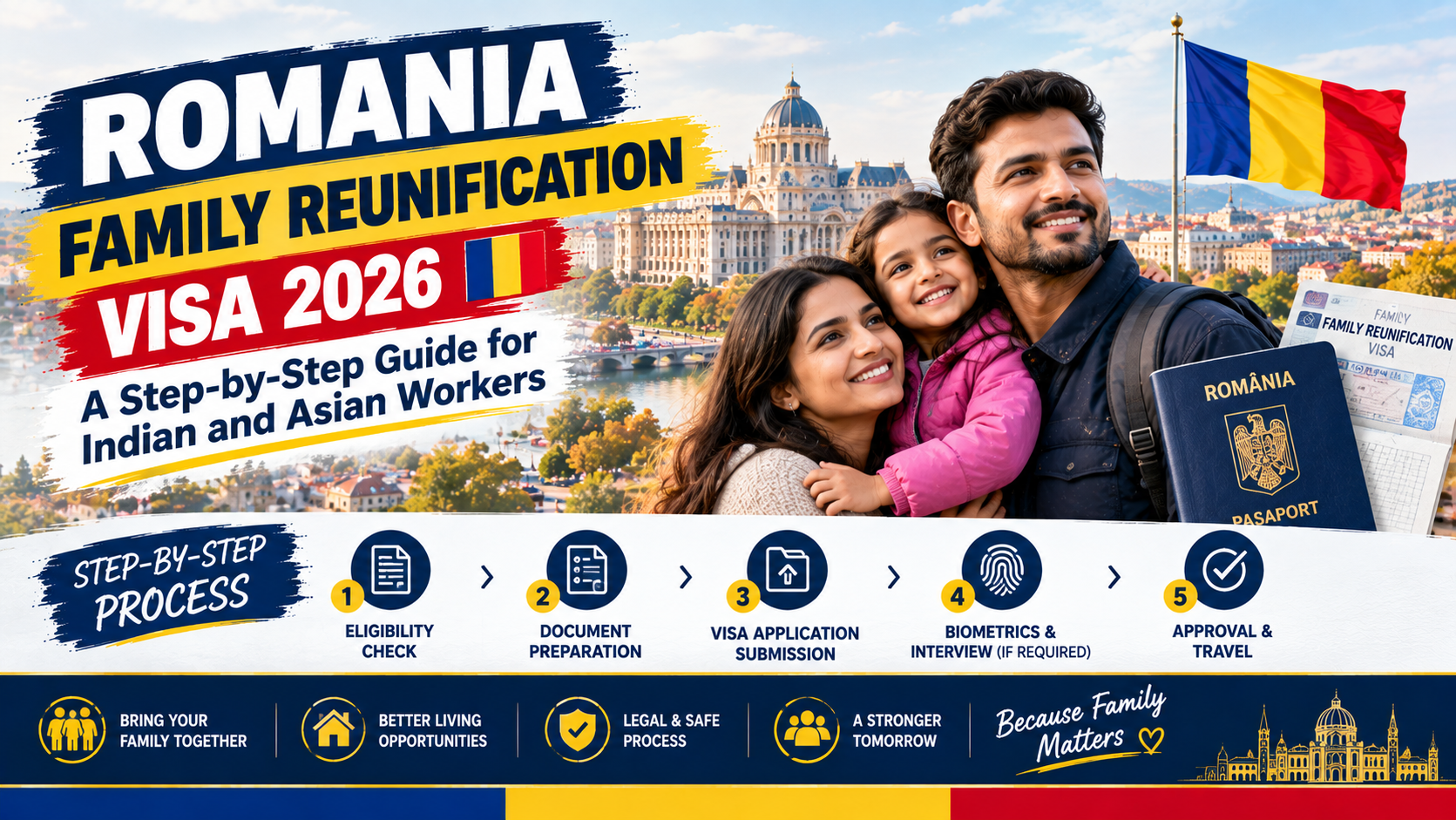

Most workers who go abroad for a job are not just going for themselves. They are going for the people they leave behind.
The salary that reaches India every month, the loan that gets paid off, the house that gets built, the sibling whose education gets funded and these are the real reasons a worker packs a bag and spends years away from home. The Romania family reunification visa is the legal pathway that allows those same workers, once they have established themselves in Romania, to end that separation.
This guide explains the Romania family reunification visa process completely. Who is eligible, when you can apply, what documents you need, how the process works at both the Romanian immigration authority and the Romanian Embassy in India, and what it actually means for your family’s life once they join you.
Romania’s Schengen membership since 2025 makes this moment specifically significant. A family that joins you in Romania through the Romania family reunification visa does not just get to live in Romania. They get a residence document that allows travel across 29 European countries. For children who will grow up with that access, and for a spouse who will live in a European capital with EU labor protections, this is a fundamentally different quality of life than any Gulf destination can offer.
Why Romania’s Schengen Status Changes the Family Reunification Calculation
Before Romania joined Schengen in 2025, the Romania family reunification visa gave families the right to live and work in Romania specifically. That was already valuable. But the Schengen membership changes the calculation significantly.
A spouse who joins you in Romania through the Romania family reunification visa and receives a Romanian TRC (Temporary Residence Card) for family reunification can travel across the Schengen Area for personal purposes without a separate visa. This means Italy, France, Germany, Austria, Spain, Greece, and 23 other countries are accessible for holidays, family visits, or even exploring future opportunities.
For children who join through the Romania family reunification visa and grow up in Romania, the educational and professional exposure to European standards, languages, and opportunities is a genuine long-term advantage that their peers in India or the Gulf simply do not have.
The Romania family reunification visa in 2026 is not just about being together. It is about what kind of future you are building for your family in a country that is a full EU and Schengen member.
Eligibility: Who Can Apply and When
The Romania family reunification visa has specific eligibility conditions that must be met before you can submit an application. Understanding these before your first year in Romania ends helps you plan and prepare correctly.
How Long Do You Need to Be in Romania First?
The general requirement for the Romania family reunification visa is that you must have held a valid TRC (Temporary Residence Card) for at least one year before applying. This one-year period does not need to be on a single continuous uninterrupted basis but your legal status in Romania must have been maintained throughout.
One year of TRC means one year of active legal employment in Romania with a valid work permit. Workers who arrive, work legally, renew their TRC on time, and maintain their employment contract meet this condition.
Some exceptional circumstances may allow applications before the one-year threshold, including workers on particularly long initial contracts or workers whose employers submit applications under specific employer guarantees. However, for most Indian workers planning a Romania family reunification visa, the one-year TRC milestone is the practical starting point.
This timeline means workers who arrived in Romania in early 2026 should be having serious conversations with their agency about the Romania family reunification visa process starting in early 2027. Preparation during year one makes the process significantly smoother.
Minimum Salary Requirements
The Romania family reunification visa requires the sponsoring worker, meaning you, to demonstrate sufficient income to support yourself and each family member you are bringing to Romania without needing social assistance.
The income threshold is calculated based on the Romanian net minimum wage per family member. In 2026, the Romanian net minimum wage is approximately Euro 470 per month per person. For a worker sponsoring a spouse and one child, the combined threshold is approximately Euro 1,410 net per month.
Most skilled trade workers in Romania meet this threshold comfortably. A Romanian mason earning Euro 1,250 net per month meets the single family member threshold. A welder or electrician earning Euro 1,500 to Euro 1,800 net per month comfortably meets the threshold for a spouse and one child.
The income demonstration must be documented through Romanian bank statements and payslips for the preceding twelve months. This is one of the reasons maintaining your salary in a documented Romanian bank account from your first month in Romania matters beyond just personal convenience.
Accommodation Requirements
The Romania family reunification visa requires you to demonstrate suitable accommodation for your family in Romania. The accommodation must meet minimum space requirements for the number of people who will be living there.
For workers in employer-provided shared worker accommodation, this is often the most complicated aspect of the Romania family reunification visa process. A shared room in worker housing is not considered suitable accommodation for a family. If you are bringing your spouse and children, you need a private apartment or at minimum private rooms with kitchen access.
Some employers arrange private accommodation for workers who are sponsoring family reunification. Others provide an accommodation allowance that workers use to rent private accommodation independently. Discuss this with your employer before submitting the Romania family reunification visa application. An employer who has invested in your placement and wants to retain you for contract renewal has a reasonable incentive to support suitable accommodation arrangements.
Rental agreements for private apartments in Romanian cities are the standard accommodation proof for the Romania family reunification visa. The agreement must be in your name and must show a minimum rental period that covers the requested visa duration.
Who Can You Bring to Romania?
The Romania family reunification visa covers specific family categories under Romanian immigration law implementing the EU Family Reunification Directive.
Your spouse or legally registered partner is eligible. Romania recognizes marriages registered under any legal system including Indian civil marriages and religiously conducted marriages registered with government authorities. Your marriage certificate must be apostilled for Romanian legal recognition.
Your children under 18 years of age are eligible regardless of whether they are biological children or legally adopted children. Children above 18 are generally not covered under the standard Romania family reunification visa process unless they have a separate disability-based dependency claim.
Dependent parents are covered under some circumstances where the sponsoring worker can demonstrate that the parents are genuinely financially dependent on them and have no other family support. This is assessed case by case and is generally more complex to establish than spouse or minor child reunification.
The Romania family reunification visa does not automatically cover siblings, extended family members, or other relatives regardless of personal financial dependency claims. These cases require specialized legal advice from a Romanian immigration specialist rather than a standard agency application process.
Step-by-Step: The Romania Family Reunification Visa Process
Step 1: Prepare Your Supporting Documents in Romania
Before any application is submitted, you need to prepare the documentation from your side as the sponsor in Romania.
This includes twelve months of Romanian bank statements showing regular salary deposits meeting the income threshold. Pay slips from your employer covering the same twelve-month period. Your current valid TRC card. Your employment contract showing contract duration and salary. Your rental agreement for private accommodation suitable for your family. Health insurance documentation showing coverage for yourself that can be extended to family members.
Start collecting these documents from month ten of your first year in Romania. Do not wait until the year is complete to begin gathering them. Some documents, particularly bank statements and employer letters, take time to obtain in proper format.
Step 2: Application at IGI and General Inspectorate for Immigration Romania
The Romania family reunification visa process begins in Romania, not in India. You submit the initial application to the General Inspectorate for Immigration Romania at the IGI office in your city.
The application form is available from the IGI office or from the IGI website. Submit the completed form along with your supporting documents as the sponsor. The IGI reviews your application against the eligibility criteria including your TRC validity, your income documentation, and your accommodation proof.
If your application meets the requirements, the IGI issues an approval document for family reunification. This is the critical first step. Without this approval from the Romanian immigration authority, the visa application at the Romanian Embassy in India cannot proceed.
Processing time at IGI for Romania family reunification visa sponsor applications is typically four to eight weeks. During this time, the immigration authority may request additional documents or clarifications. Respond to any such requests promptly to avoid delays.
Step 3: Send the Approval Document to Your Family in India
Once IGI issues the family reunification approval, you send this document to your family in India. The approval document confirms that Romanian immigration authorities have assessed your application and found you eligible to sponsor family members for residence in Romania.
This document is the authorization your family members need to apply for their visas at the Romanian Embassy in New Delhi.
Step 4: Visa D/VF Application at Romanian Embassy in New Delhi
Your spouse and children apply for a Romania family reunification visa, technically designated as Visa D/VF (long-stay visa for family reunification), at the Romanian Embassy in New Delhi.
The Romanian Embassy in New Delhi handles visa applications from Indian nationals. Your family members will need to book an appointment and attend in person.
Documents required for the Romania family reunification visa application at the embassy include the original IGI approval document sent from Romania, valid Indian passports for each family member applying, apostilled marriage certificate for the spouse, apostilled birth certificates for each child, proof of relationship (family certificate or equivalent), passport photographs to Romanian visa specification, completed visa application forms for each applicant, and health insurance documentation.
Visa processing time at the Romanian Embassy in New Delhi for Romania family reunification visa applications is typically three to six weeks after a complete application is submitted.
Document Checklist: Romania Family Reunification Visa
The Apostille Requirement
| Document | Who Prepares It | Key Requirement |
| IGI approval document | You (sponsor in Romania) | Obtained from IGI after sponsor application approval |
| Valid Indian passports | Family members in India | Minimum 2 years remaining validity per passport |
| Marriage certificate | Family (original) | Must be apostilled for Romanian recognition |
| Birth certificates of children | Family (originals) | Must be apostilled for Romanian recognition |
| Romanian bank statements (12 months) | You (sponsor) | Shows regular salary meeting income threshold |
| Romanian payslips (12 months) | You (sponsor) | Confirms employment and salary level |
| Rental agreement for private apartment | You (sponsor) | Must be in your name with adequate space for family |
| Health insurance documentation | You (sponsor) | Confirms coverage and family extension possibility |
| Current TRC card | You (sponsor) | Copy sent to family for embassy application |
| Employment contract | You (sponsor) | Shows contract validity beyond family’s intended arrival |
| Visa application forms | Family members | Separate form for each applicant |
| Passport photographs | Family members | Romanian visa specification, white background |
The apostille is an internationally recognized form of document authentication that confirms a document’s origin and the authority of the official who signed it. Romanian immigration law requires apostilled versions of key documents including marriage certificates and birth certificates.
In India, the apostille is issued by the Ministry of External Affairs. The process involves first getting the document attested by the relevant state authority and then sending it to the MEA for apostille stamping. This process takes two to four weeks in most cases.
For workers planning a Romania family reunification visa application, it is strongly advisable to have key family documents apostilled during year one in Romania, not when the application is imminent. Documents age. An apostille issued two years before the application may be questioned. Getting documents apostilled approximately six months before the intended application date is the practical approach.
The Schengen Benefit for Families
Once your family members receive their Romania family reunification visa and enter Romania, they apply for their own TRC cards. This process mirrors what you went through when you first arrived. Within 90 days of entry, each family member submits a TRC application at the local IGI office.
The TRC issued under Romania family reunification visa provisions gives your family members the right to live in Romania for the duration covered by the card. For a spouse, this also includes the right to work in Romania without a separate work permit, which is a significant benefit if your spouse wants to pursue employment.
Beyond Romania itself, the TRC as a Romanian residence document allows Schengen Area travel. Your family can take holidays to Italy, Greece, Croatia, France, or any other Schengen country without visa applications. Family visits within the Schengen Area for up to 90 days in any 180-day period are covered.
For children who grow up in Romania after joining through the Romania family reunification visa, enrollment in Romanian state schools is available. Romanian state education is free for TRC holders and provides access to a European standard curriculum with strong mathematics and science programs. Romanian universities are EU-accredited and offer degree programs in English, making higher education transition accessible for families planning longer-term stays.
Challenges and Real Tips From the Process
The Romania family reunification visa process is manageable but it is not quick. Families who understand the challenges before they begin are better prepared to navigate them without panic.
Processing times add up. The IGI sponsor application takes four to eight weeks. The embassy visa application takes three to six weeks. Apostille processing in India takes two to four weeks. Between the moment you decide to apply and the moment your family boards a flight to Bucharest, four to six months is a realistic expectation. Workers who want their family in Romania by a specific date need to plan backward from that date and start the process accordingly.
Accommodation costs change your monthly savings. Before the Romania family reunification visa, most workers live in employer-provided accommodation with minimal personal expense. After bringing a family, private apartment rental costs Euro 300 to Euro 600 per month in most Romanian cities outside Bucharest. This is a real change in your monthly savings rate. Read our cost of living in Romania guide to understand the full financial picture before committing to a family move timeline.
Romanian language affects your children’s daily life in ways that take time to resolve. Schools in Romania teach in Romanian. A child who arrives speaking only Hindi or English will face a language adjustment period. Most Romanian schools have some experience with non-Romanian speaking children from the Indian and Asian worker communities, and children typically adapt faster than adults. But the first school year after a Romania family reunification visa arrival is an adjustment for children and parents both.
Integration into the Indian worker community in Romania significantly reduces these adjustment challenges. Families connected to existing Indian community groups in Bucharest, Cluj, or other cities where Indian workers are concentrated report much smoother settling-in experiences than families who arrive without those connections.
Romania vs the Gulf: Why Romania Is Better for Indian Families
Most Indian workers who have spent time in the Gulf know what family life looks like in a Gulf country. High-value neighborhoods in Dubai are accessible to senior professionals on high packages. But for the blue-collar construction or manufacturing worker, the Gulf family experience is a specific and limited one.
Dependent visas in Gulf countries require specific salary thresholds that many blue-collar workers do not meet. Accommodation in compounds or labour camps does not accommodate families. Schools for non-Arab expat children range from affordable to extremely expensive depending on location and quality.
And the fundamental issue is permanence. There is no path to residency for Indian workers or their families in Gulf countries that is independent of continued employment. The family’s right to be there ends when your work contract ends.
Romania’s family reunification framework under EU law creates a different situation. After five years of legal residence, both you and your family members become eligible for long-term resident status on the path toward Romanian permanent residency, which is covered in full detail in our Romania permanent residency guide. The family’s legal status in Romania is not entirely dependent on your continued employment the way Gulf residency is. Children who complete their education in Romania and build a legal residence record here have genuine long-term options that Gulf-born children of Indian workers simply do not.
This is not a small difference. It is a structural difference in what your years abroad can actually produce for your family’s future.
Frequently Asked Questions
How long do I need to work in Romania before applying for the Romania family reunification visa?
Generally one year of valid TRC residence in Romania is required before submitting the Romania family reunification visa sponsor application at IGI. Workers should begin preparing documents and apostilling family certificates during their first year so everything is ready when the one-year threshold is reached.
What is the minimum salary required for the Romania family reunification visa?
The income threshold is based on the Romanian net minimum wage per family member. In 2026, this is approximately Euro 470 per month per person. Sponsoring a spouse and one child requires approximately Euro 1,410 net per month. Most skilled trade workers in Romania meet or exceed this threshold.
Can my spouse work in Romania after joining me through the Romania family reunification visa?
Yes. A spouse who enters Romania through the Romania family reunification visa and receives a TRC under family reunification provisions has the right to work in Romania without a separate work permit. This is a significant benefit compared to Gulf family visa arrangements where spouse work rights are more restricted.
How long does the Romania family reunification visa process take?
The complete process from starting the IGI sponsor application to your family’s arrival in Romania takes approximately four to six months. IGI processing takes four to eight weeks. Embassy visa processing takes three to six weeks. Apostille preparation in India adds two to four weeks if not done in advance.
Do my children need to learn Romanian for school in Romania?
Yes. Romanian state schools teach in Romanian and children will need to develop Romanian language ability. Most children adjust within the first school year. Romania’s Ministry of Education provides Romanian language support for non-Romanian speaking children in some schools. International schools teaching in English are available in major cities but carry significant tuition costs.
Does the Romania family reunification visa give Schengen travel rights?
Yes. Once your family members receive their Romanian TRC after entering on the Romania family reunification visa, they can travel across the Schengen Area for personal travel purposes for up to 90 days in any 180-day period without additional visas.