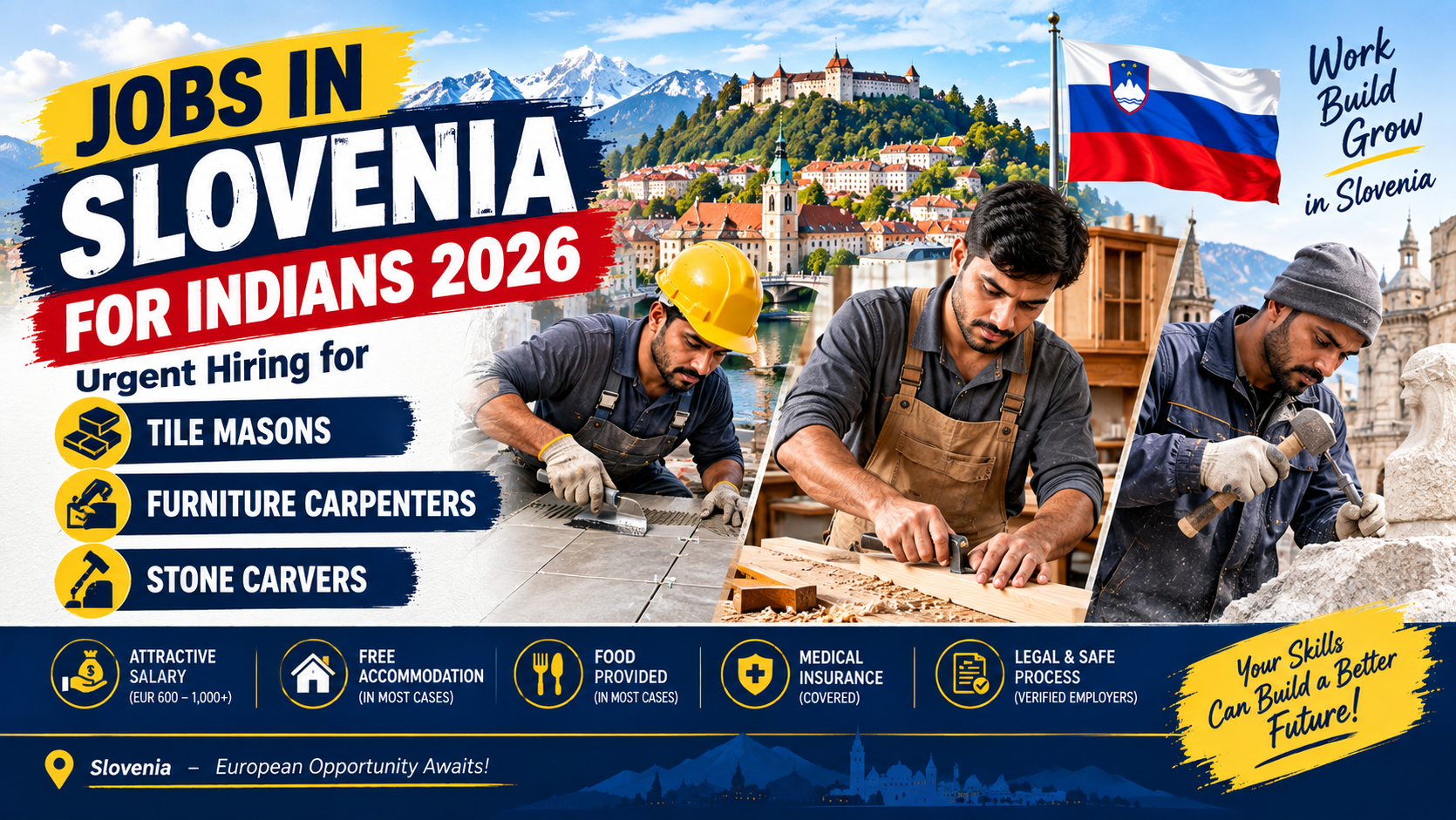
Jobs in Slovenia for Indians in 2026 are open right now, and this guide exists because we need to fill specific skilled trade vacancies immediately.
If you are a tile mason, furniture carpenter, or stone carver with verified experience and your documents ready, read this guide completely. We have active employer requirements for all three of these roles in Slovenia and the application window for current slots is open now.
Beyond the urgency, Slovenia deserves a full explanation for any Indian skilled worker who has not yet considered it. Jobs in Slovenia for Indians are not widely discussed in the overseas recruitment community. That is precisely what makes this opportunity real. Most Indian workers are competing for the same Romania, Germany, and Poland vacancies. A much smaller pool of qualified candidates is aware that Slovenia, a full EU and Schengen member, has active demand for the exact trades this guide covers. Less competition for the same EU-standard legal employment means faster processing and better employer attention to individual candidates.
Why Slovenia is the Hidden Gem of the Schengen Area
Jobs in Slovenia for Indians represent one of the most underutilised legal EU employment opportunities available in 2026.
Slovenia is a small country of approximately two million people located in Central Europe, bordering Italy, Austria, Hungary, and Croatia. It is a full European Union member since 2004 and a Schengen Area member. Its capital Ljubljana and second city Maribor are modern, well-developed European cities with established infrastructure.
Slovenia’s economy punches well above its size. GDP per capita is among the highest in Central and Eastern Europe. The country has a strong manufacturing sector, significant construction activity, and a premium interior finishing market driven by high-end residential and hospitality projects. Slovenian wages for skilled trades are among the most competitive in the region.
The labor shortage problem driving jobs in Slovenia for Indians is structural. Slovenia has low unemployment and a high rate of Slovenian-trained tradespeople moving to Austria and Germany for the wage premium that freedom of movement provides. The result is that Slovenian employers in construction, furniture manufacturing, and restoration are actively seeking skilled workers from outside the EU to fill experienced trade positions.
Current Urgent Vacancies: Jobs in Slovenia for Indians Right Now
We have active employer requirements for three specific trades. These are not speculative future vacancies. These are current requirements from verified Slovenian employers who are ready to initiate work permit applications for qualified candidates immediately.
Vacancy 1: Furniture Carpenters
Jobs in Slovenia for Indians as furniture carpenters are available for workers with experience in high-end wood-working, interior joinery, and furniture assembly for residential and commercial projects.
Slovenian employers in this category are not looking for general carpentry or formwork experience. They need workers who understand timber joinery and wood finishing, can work from technical drawings and cutting lists, have experience with wood-working machinery including panel saws, edge banders, CNC routing machines, and spindle moulders, understand wood species and their working properties, and can produce finished joinery to high visual quality standards required for interior residential and hospitality projects.
Workers with experience in furniture manufacturing plants, high-end kitchen or wardrobe companies, or interior joinery workshops in India or the Gulf are the right profile for these jobs in Slovenia for Indians.
Vacancy 2: Tile Masons
Jobs in Slovenia for Indians as tile masons cover residential and commercial finishing work on high-specification projects across Ljubljana, Maribor, and surrounding areas.
Slovenian tile mason requirements are specifically for workers with experience in large-format tile installation (tiles above 60x60cm), stone tile and marble installation on floors and walls, waterproofing preparation for wet areas including bathrooms and swimming pools, adhesive selection and substrate preparation for different tile formats and substrates, and grout and sealant application to professional standards.
Basic tile laying on simple ceramic tiles in standard residential kitchens is not the profile these jobs in Slovenia for Indians are looking for. Employers want workers who have done finishing work on premium construction projects where the visual quality of the tiled surfaces is a primary deliverable.
Vacancy 3: Stone Carvers
Jobs in Slovenia for Indians as stone carvers are the most specialised category and the one with the least competition from other workers globally.
Slovenia has a strong tradition of stone architecture and restoration work. Demand for skilled stone carvers exists across two distinct contexts. New construction projects involving decorative stone elements for premium residential buildings, hotels, and public buildings. Heritage restoration projects where existing carved stone elements on historical buildings need to be repaired or replicated to match existing profiles.
Indian stone carvers, particularly from regions with strong stone carving traditions including Rajasthan, Gujarat, and parts of Maharashtra, have skills that are directly transferable to Slovenian stone carving requirements. Workers with experience carving in sandstone, marble, granite, or limestone are the primary profile.
The stone carver vacancies in jobs in Slovenia for Indians are limited in number and require documentation of previous stone carving work. Photographs of past work, even informal photos of projects, significantly strengthen applications for these positions.
Salary and Benefits: Jobs in Slovenia for Indians in 2026
| Trade | Monthly Gross (Euro) | Monthly Net (Euro approx) | Monthly INR (approx) | Accommodation | Meals |
| Furniture Carpenter (2 to 4 years) | Euro 1,400 to Euro 1,700 | Euro 1,080 to Euro 1,310 | Rs 97,200 to Rs 1,17,900 | Included | Allowance |
| Furniture Carpenter (5+ years) | Euro 1,700 to Euro 2,100 | Euro 1,310 to Euro 1,620 | Rs 1,17,900 to Rs 1,45,800 | Included | Allowance |
| Tile Mason (3 to 5 years) | Euro 1,500 to Euro 1,900 | Euro 1,160 to Euro 1,470 | Rs 1,04,400 to Rs 1,32,300 | Included | Allowance |
| Tile Mason (6+ years premium) | Euro 1,800 to Euro 2,200 | Euro 1,390 to Euro 1,700 | Rs 1,25,100 to Rs 1,53,000 | Included | Allowance |
| Stone Carver (any experience) | Euro 1,600 to Euro 2,400 | Euro 1,240 to Euro 1,860 | Rs 1,11,600 to Rs 1,67,400 | Included | Included |
Exchange rate: Euro 1 = Rs 90. Slovenian income tax and social contributions reduce gross by approximately 23 percent for most income levels. Net take-home is approximately 77 percent of gross.
Stone carver roles carry a premium because qualified workers are rare globally, not just in Slovenia. Workers in this category with strong documentation of their skills can negotiate at the higher end of the salary range.
For a comparison of salary packages for similar trades in Romania, see our Romania job salary guide.
Overtime and Project Completion Bonuses
Jobs in Slovenia for Indians in construction and finishing trades frequently involve overtime during project push periods. Overtime is paid at a minimum of 130 percent of the regular hourly rate under Slovenian labor law. Some employers also offer project completion bonuses for workers who complete high-quality work to deadline on specific projects.
The Slovenia Single Permit Process: How Jobs in Slovenia for Indians Work Legally
Slovenia uses the EU Single Permit system for non-EU workers. This is known in Slovenia as the “enotno dovoljenje” (unified permit) and it combines the work permit and residence permit into a single document issued by Slovenian authorities.
Step 1: Employer Labour Market Test via ZRSZ
Before a Slovenian employer can hire a non-EU worker for jobs in Slovenia for Indians, they must apply to the Slovenian Employment Service, known as ZRSZ, to conduct a labour market test. This test confirms that the position cannot be filled by an available local Slovenian or EU worker.
The Slovenian Employment Service ZRSZ processes labour market test applications and issues a certificate confirming the employer can proceed with a non-EU hire for the specific role. This step takes approximately two to six weeks depending on the trade category and the ZRSZ office processing the application.
Step 2: Single Permit Application
With the ZRSZ labour market test certificate in hand, the employer submits a single permit application to the Slovenian Ministry of Interior. The application includes the employer’s documentation, your passport copies, your employment contract, and your trade qualification documents.
The single permit for jobs in Slovenia for Indians is the “Informativity list” (information sheet) that serves as the legal basis for your D-type visa application at the Slovenian Embassy. Processing time at the Ministry of Interior for single permit approval is typically four to eight weeks.
Step 3: D-Type Visa at Slovenian Embassy
With the single permit approved, you apply for a D-type long-stay visa at the Slovenian Embassy in New Delhi. Slovenia’s Embassy in New Delhi handles visa applications from Indian nationals. Documents required include your passport, the approved single permit, your signed employment contract, proof of accommodation arranged in Slovenia, medical certificate, Indian PCC, and photographs.
Visa processing time at the Slovenian Embassy is typically two to four weeks.
Step 4: Arrival and Single Permit Card Collection
After arriving in Slovenia on your D-type visa, you collect your physical single permit card from the local administrative unit. This card is your unified residence and work permit for the duration of your employment contract. It is valid for the period of your contract and is renewed when your contract is extended.
Total process time from job offer to arrival in Slovenia for jobs in Slovenia for Indians is approximately three to five months. This is comparable to the Romania D/AM2 process timeline.
The Schengen Advantage: What Jobs in Slovenia for Indians Actually Give You
Slovenia’s Schengen membership is one of the most significant aspects of jobs in Slovenia for Indians that most guides underemphasize.
A Slovenian single permit holder has the right to travel freely within the Schengen Area for personal purposes. The Schengen Area currently covers 29 European countries including Germany, France, Italy, Spain, Austria, the Netherlands, Poland, and Romania. With a valid Slovenian single permit and passport, you can take personal trips to any of these countries without a separate visa.
This travel freedom is genuinely different from what Gulf employment provides. A worker in Dubai cannot visit Paris on a weekend without a separate Schengen visa application. A worker holding a Slovenian single permit through jobs in Slovenia for Indians can drive to Italy or Austria on a day off.
The Schengen travel right covers personal travel only, not work rights. Working in other Schengen countries requires separate work authorization in each country. But for personal travel, cultural exploration, and building a practical understanding of Europe, Schengen membership transforms the quality of life for Indian workers placed through jobs in Slovenia for Indians.
Accommodation and Living in Slovenia
Jobs in Slovenia for Indians arranged through licensed agencies include employer-provided accommodation for all three trade categories currently hiring.
In Ljubljana, accommodation is typically in shared apartments within commuting distance of the project or factory site. Ljubljana is a compact, walkable city with good public transport. Daily costs outside of accommodation are moderate by Western European standards.
In Maribor, Slovenia’s second city, accommodation costs are lower and the city has a strong industrial employment base around its manufacturing sector. Indian worker communities are smaller in Maribor than in Ljubljana but the city has all necessary services and reasonable quality of life for workers on full-package contracts.
Most employers providing jobs in Slovenia for Indians include a monthly food allowance. Stone carver roles in our current vacancies include full meals as part of the package, which further reduces monthly personal expenses.
Personal expenses for workers with accommodation and food allowance provided are typically Euro 100 to Euro 200 per month for transport, phone, personal items, and occasional entertainment. This means monthly savings for most trade levels in jobs in Slovenia for Indians are Euro 800 to Euro 1,500 per month depending on the specific role and salary level.
How to Apply Right Now: Urgent Slots for Tile Masons, Furniture Carpenters, and Stone Carvers
These are the specific steps to apply for the current urgent vacancies in jobs in Slovenia for Indians.
First, browse open roles on our careers page. Filter for Slovenia or look for the current tile mason, furniture carpenter, and stone carver listings. Every listing shows the salary range, contract type, and package details.
Second, apply for free through our application form. In your application, specify your exact trade, your years of experience in that specific trade, and the types of projects you have worked on. General responses about “construction experience” do not help us assess your fit for these specific skilled trade roles.
Third, prepare your documentation before we call you. Workers who have the following ready move through the process fastest: Original passport with minimum two years remaining validity. ITI certificate or equivalent trade qualification certificate. Work experience letters from previous employers specifically confirming your trade role and years worked. If you have Gulf experience, an employment letter from your Gulf employer confirming your carpentry, tiling, or stone carving work. Photographs of your previous work if available, particularly for stone carvers and furniture carpenters. These photographs are genuinely useful and can accelerate employer interest.
Fourth, be ready for a video trade assessment. Employers for jobs in Slovenia for Indians in these three categories will conduct a brief video call to ask about your specific trade skills before confirming placement. This is standard. Prepare to describe the types of materials you have worked with, the largest projects you have completed, and the specific techniques you use in your trade.
Our team speaks Hindi, Nepali, Bengali, and Tamil. Language will not be a barrier to the assessment process.
Why Slovenia Is a Long-Term Career Move, Not Just a Job
Workers who take jobs in Slovenia for Indians are not just taking a one-year contract. They are making a strategic investment in a European employment record that has lasting value.
A completed Slovenian single permit employment contract gives you a documented, verified EU work history in a skilled trade. This record is recognized by employers across EU member states when you apply for future contracts. Moving from Slovenia to Austria or Germany in your second overseas contract is a path that several workers with EU-adjacent experience have already taken successfully.
Slovenia’s single permit pathway also continues year after year with contract renewals. Workers who demonstrate strong performance and maintain good relationships with Slovenian employers often find their contracts renewed or upgraded to senior positions. Slovenia does not have the same annual quota constraints that Romania’s 90,000 non-EU worker limit creates, which means the renewal environment is more flexible.
And for workers thinking long-term, after five years of continuous legal residence in Slovenia, a path to Slovenian permanent residency exists under EU long-term resident directive. Slovenian permanent residency carries the same Schengen travel benefits as any other EU permanent residency document.
Jobs in Slovenia for Indians in 2026 are an entry point into a European skilled trade career. For tile masons, furniture carpenters, and stone carvers who are ready to apply now, the immediate opportunity is real and the long-term trajectory is genuinely valuable.
Apply for free today. These slots will not remain open for long.
Frequently Asked Questions
What are the current urgent jobs in Slovenia for Indians in 2026?
Current urgent jobs in Slovenia for Indians in 2026 cover three specific trades: furniture carpenters with high-end woodworking experience, tile masons with large-format and stone tile experience, and stone carvers with decorative or restoration carving skills. These are active vacancies from verified Slovenian employers ready to initiate single permit applications immediately for qualified candidates.
How long does the Slovenia work permit process take for Indian workers?
The full process for jobs in Slovenia for Indians takes approximately three to five months from job offer to arrival. The ZRSZ labour market test takes two to six weeks, single permit approval at the Ministry of Interior takes four to eight weeks, and D-type visa processing at the Slovenian Embassy in New Delhi takes two to four weeks.
Is Slovenia in the Schengen Area?
Yes. Slovenia is a full Schengen member. Workers holding a valid Slovenian single permit can travel freely across all 29 Schengen member countries for personal purposes without requiring additional visas. This Schengen travel access is one of the significant advantages of jobs in Slovenia for Indians over Gulf employment.
What salary can I expect for jobs in Slovenia for Indians as a tile mason?
Tile masons in jobs in Slovenia for Indians earn approximately Euro 1,160 to Euro 1,700 net per month in 2026 depending on experience level. With employer-provided accommodation included, monthly savings of Euro 950 to Euro 1,450 are realistic. Over a two-year contract, total savings range from approximately Rs 20 to Rs 31 lakh.
Do I need to speak Slovenian for jobs in Slovenia for Indians?
Slovenian language is not a requirement at entry level for most trade roles in jobs in Slovenia for Indians. Basic communication in the workplace is managed through site supervisors and team leaders who communicate with Indian workers in English or through translators. Learning basic Slovenian improves daily life and career progression over time.
What documents do I need to apply for jobs in Slovenia for Indians?
Core documents for jobs in Slovenia for Indians include your valid passport, ITI or trade qualification certificate, work experience letters from previous employers confirming your specific trade role, PCC from India, medical certificate, and photographs of previous trade work particularly for carpenter and stone carver roles. Gulf experience documentation is a strong additional advantage.